Fold it in software first.

Wilby Labs designs DNA nanostructures and is building a simulator that predicts their shape, motion and assembly yield before a single strand is ordered.

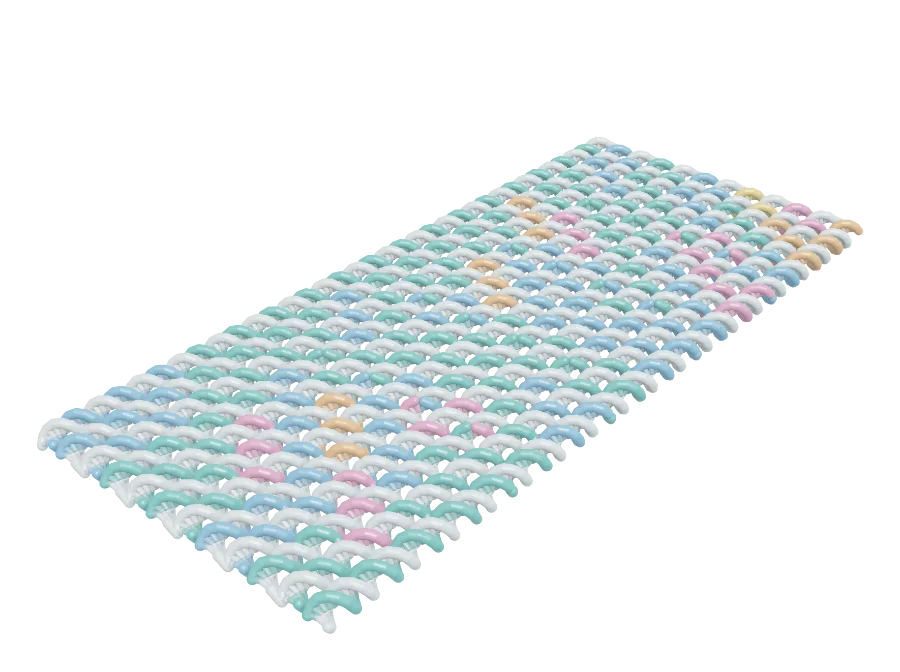
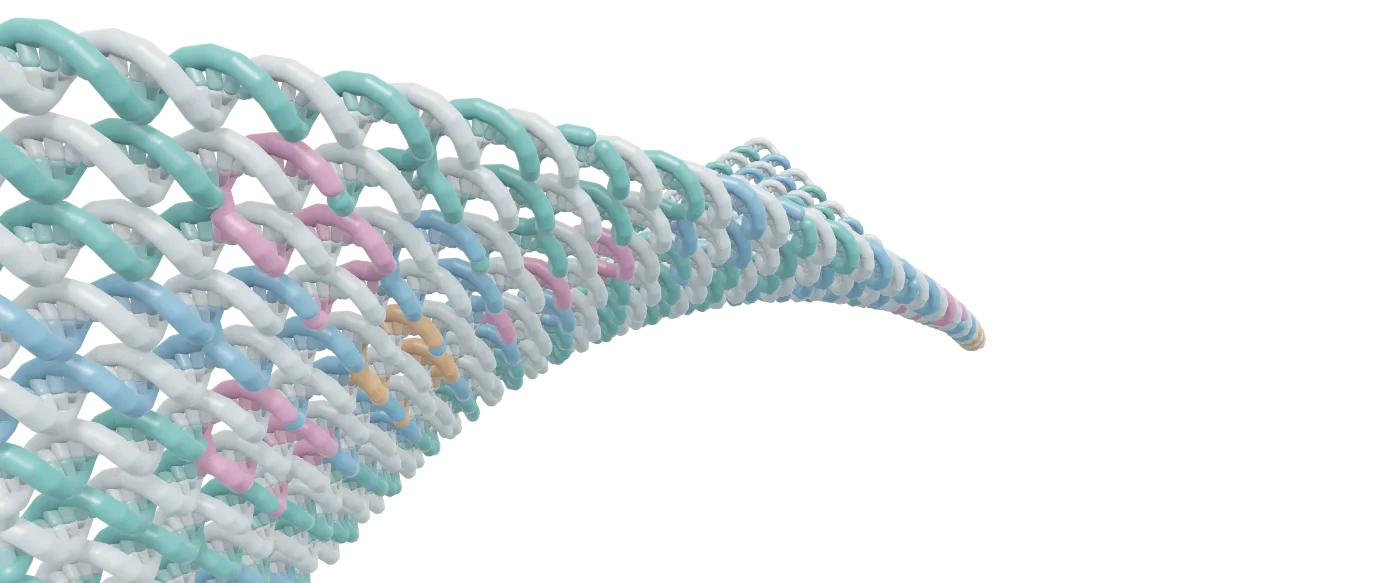
A sheet of twelve DNA double helices, twisted end to end into a bow-tie shape. Staple strands are pastel teal, blue, pink and amber over a pale scaffold.
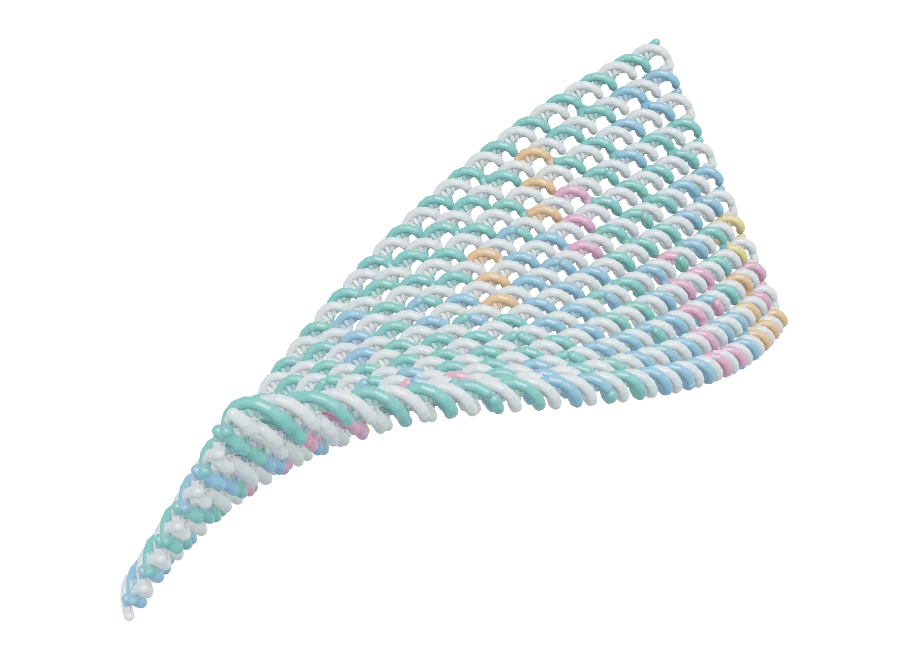
Our 12-helix test sheet, rendered from its design file with the 115° end-to-end twist the elastic model predicts. The twist is spread evenly along the sheet for display.
Status
In active development
Reads
cadnano and scadnano designs
Predicts
Assembly yield, shape, dynamics and failure modes
Exports
Pre-relaxed oxDNA configurations

Today you find out at the end. A DNA origami folds when dozens to a few hundred short staple strands pin a long scaffold strand into shape, over an anneal that can run for hours. If the design misfolds, the gel tells you afterwards. A good prediction moves that answer to the start.

Four layers, from milliseconds to hours.

The simulator is built in four layers. The fast ones answer most design questions in minutes. The slower ones check them, with oxDNA as the reference at the end.

Sequence

Nearest-neighbor thermodynamics and crosstalk screens

Assembly

Domain-level stochastic folding with loop-closure cooperativity

Mechanics

Base-pair elastic network and Brownian dynamics

Nucleotide

oxDNA2 molecular dynamics, on a GPU where possible

The folding model follows every staple through the anneal.

It works at the level of binding domains1,2. Staples bind and unbind one domain at a time, and each bound domain makes the next loop easier to close. The report gives the assembly yield, the share of simulated anneals that end with every staple bound, along with where in the anneal the structure folds and which staples are the weak points.

rectangle_12h12 helices, 63 staples, 2,256 base pairs

Model output

Staple map of the test sheetTwelve helices drawn as rows. The scaffold runs back and forth through all of them. 37 staples have a domain that melts at 55 °C or above, 22 have their strongest domain between 45 and 55 °C, and 4 have every domain below 45 °C: s2, s6, s8, s14. Those four are circled. Staple map of the test sheetTwelve helices drawn as columns. The scaffold runs back and forth through all of them. 37 staples have a domain that melts at 55 °C or above, 22 have their strongest domain between 45 and 55 °C, and 4 have every domain below 45 °C: s2, s6, s8, s14. Those four are circled.
  • Strongest domain melts at 55 °C or above
  • 45 to 55 °C
  • Every domain melts below 45 °C
  • Scaffold

Share of binding domains bound as the anneal cools

From 80 °C to 65 °C at 1 minute per degree, then to 25 °C at 10 minutes per degree, in 12.5 mM magnesium.

What this run found

  • All 16 simulated anneals ended with every staple bound. With 16 runs, the 95 percent interval on the yield is 81 to 100 percent. The model does not simulate misbinding; it is screened separately and reported beside the yield.
  • Four staples lack a strong seed. All of their domains melt below 45 °C, so the report suggests re-cutting them. s2s6s8s14
  • Five off-target matches compete. Each is at least 70 percent as strong as its staple’s strongest intended domain. See the design checks
Predicted for the test sheet. Temperatures are not yet calibrated against a lab measurement, and published sheets like this one usually fold several degrees lower. Read the shape of the curve and the ranking between designs, not the absolute numbers.

The test sheet twists because of how it was drawn.

A base-pair elastic network, built on the physics of CanDo3, relaxes the design in 3D and reports its twist, bend and flexibility. This sheet is laid out at 10.67 base pairs per turn, looser than the 10.5 that DNA prefers, so it winds up along its length. Deleting one base pair in every 64 roughly halves the twist.

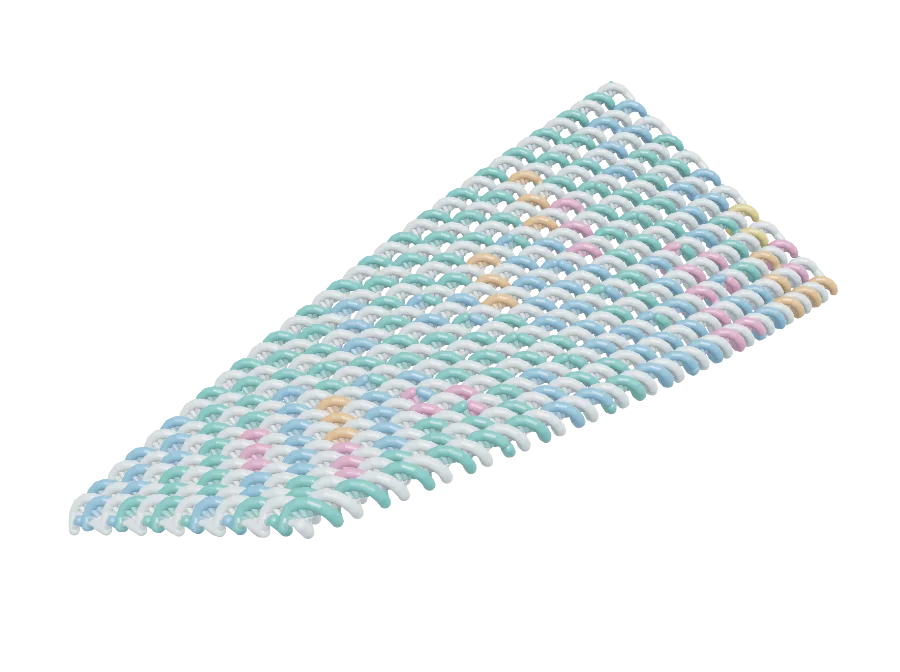
The test sheet as laid out in the design file. It is flat. The sheet at the predicted twist of 179 degrees per 100 nanometers. It curls strongly from one end to the other. The sheet with one base pair deleted every 64, at the predicted 87 degrees per 100 nanometers. It lies much flatter.
Show the test sheet

FlatThe layout in the design file, before any mechanics.

179° per 100 nmPredicted for the sheet as drawn: 115° from one end to the other.

87° per 100 nmPredicted with one base pair deleted every 64.

Global twist from the elastic model, rendered from the design file at each value and from the same angle. Each render spreads the twist evenly for display. In the model the edges twist more than the interior: with the deletions, the interior twists about 40° per 100 nm.
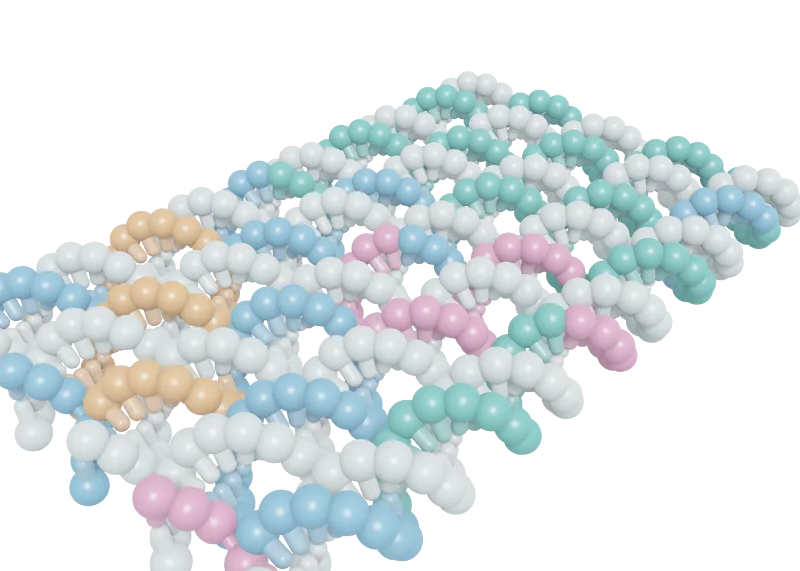
Close-up of five neighboring helices in the test sheet at nucleotide resolution. Each nucleotide is a bead, as oxDNA represents it, and staples cross between helices.

Nucleotide-level runs start from the relaxed shape.

Brownian dynamics of the elastic model shows how much each part of a structure moves. When a question needs single-nucleotide detail, the simulator writes a pre-relaxed configuration for oxDNA24 and drives the run. Starting relaxed avoids the large initial strains of a raw export: the largest bond is 1.9 oxDNA units, against 5.4 in scadnano’s own export.
Design checks run on every staple.

Off-target matches on the scaffold and staple dimers are scored with the same nearest-neighbor energies5 as the intended binding, so the two can be compared directly. Hairpins are folded with the DNA parameters in ViennaRNA, and runs of four or more G are flagged from the sequence. The report names the strands involved and what to change.

Excerpt from the report for the test sheet. Free energies at 50 °C.

Weak staples
4 staples have no domain that melts at 45 °C or above. The report suggests re-cutting them so each has a strong seed of at least 14 nucleotides2,7.s2 · s6 · s8 · s14
Scaffold off-targets
5 matches are at least 70 percent as strong as the staple’s strongest intended domain. The strongest, on s49, binds at −9.2 kcal/mol. That is stronger than two of s49’s own three domains and 71 percent of its strongest (−12.9).s49 ACGACGGCC → scaffold 713
Hairpins
23 staples can fold back on themselves. The strongest hairpin, in s24, is −6.0 kcal/mol.s24 .((((((((.........))))))))......
Runs of G
8 runs of four or more G, which can form G-quadruplexes.s6 GGGG · s15 GGGGG · s27 GGGGG

What we have checked, and what is still open.

The simulator is in active development. Each layer is checked against a reference: an exact result, a second implementation, a published measurement or oxDNA. The folding model has not yet been compared with a lab measurement. The open rows are the next work, starting with a measured annealing curve.

Validation of the simulator: each check, what it was compared with, and the result
CheckCompared withResult
Duplex melting temperatures, four sequences in three buffersAn independent implementation of the same nearest-neighbor5 and salt-correction6 parameters (Biopython)Agrees within 0.05 °C
Folding model, detailed balanceThe exact Boltzmann distribution of each staple’s bound statesAgrees to one part in a million
Strand-displacement rate against toehold lengthMeasurements by Zhang and Winfree8, whose three-step model the simulator usesReproduces the steep rise for short toeholds and the plateau near 3 × 106 M−1 s−1
Relaxed size of a test designoxDNA2, same design, same starting structure61.8 × 26.9 × 6.6 nm, against 62.4 × 29.7 × 6.3 nm
oxDNA exportscadnano’s own oxDNA exportSame conventions, with the largest bond at 1.9 oxDNA units against 5.4
Absolute folding temperatureA measured annealing curveOpen
Design-dependent yield changesPublished folding experiments by Dunn and colleagues2Open
Predicted yieldGel yields of our own designsOpen
Duplex melting temperaturesMeasured melting tables, rather than another implementationOpen

Next

  • Calibrate folding against annealing curves and gel yields from our own designs, then against published data
  • Scaffold-free assemblies such as DNA bricks and tiles
  • Misfolding modeled inside the folding simulation, not only screened
  • Staple breakpoints and scaffold rotation chosen for predicted yield
  • Hinges, rotors and walkers, combining mechanics with strand displacement

Known limits

  • Absolute folding temperatures are not calibrated. Until one annealing curve is measured, rankings between designs are more reliable than single numbers.
  • Aggregation, scaffold secondary structure and errors in staple synthesis are not modeled yet.

Every model choice has a paper behind it.

We keep an annotated library of more than 60 papers, from DNA thermodynamics to molecular machines. We surveyed the tools the field already relies on, and the simulator’s architecture follows from that survey.

What existing tools cover

Design tools such as cadnano9, scadnano10, DAEDALUS, PERDIX, ATHENA and MagicDNA turn a target shape into strand routings and sequences. They don’t say whether the design will fold. Shape predictors such as CanDo3 and mrDNA11 give fast shape and flexibility, checked against cryo-EM, but not whether the structure assembles at all.

Nearest-neighbor tables, NUPACK12 and ViennaRNA handle duplexes and small complexes, without the 3D context that makes origami folding cooperative. oxDNA4 is the best-validated model at the level of single nucleotides, but folding a whole origami with it is orders of magnitude too slow. Domain-level research code1,2 predicted design-dependent yield changes that experiments then confirmed, but it was written for specific designs.

We haven’t found a tool that connects these, from a design file to a yield that is checked against the lab. That is the gap the simulator is built for. oxDNA stays the reference: we export to it rather than rebuild it.

Papers cited on this page

  1. Modelling DNA origami self-assembly at the domain level (doi.org)Dannenberg et al., Journal of Chemical Physics, 2015
  2. Guiding the folding pathway of DNA origami (doi.org)Dunn et al., Nature, 2015
  3. A primer to scaffolded DNA origami (doi.org)Castro et al., Nature Methods, 2011
  4. Introducing improved structural properties and salt dependence into a coarse-grained model of DNA (doi.org)Snodin et al., Journal of Chemical Physics, 2015
  5. The thermodynamics of DNA structural motifs (doi.org)SantaLucia and Hicks, Annual Review of Biophysics and Biomolecular Structure, 2004
  6. Predicting stability of DNA duplexes in solutions containing magnesium and monovalent cations (doi.org)Owczarzy et al., Biochemistry, 2008
  7. Three-dimensional structures self-assembled from DNA bricks (doi.org)Ke et al., Science, 2012
  8. Control of DNA strand displacement kinetics using toehold exchange (doi.org)Zhang and Winfree, Journal of the American Chemical Society, 2009
  9. Rapid prototyping of 3D DNA-origami shapes with caDNAno (doi.org)Douglas et al., Nucleic Acids Research, 2009
  10. scadnano: a browser-based, scriptable tool for designing DNA nanostructures (doi.org)Doty et al., DNA 26, LIPIcs, 2020
  11. MrDNA: a multi-resolution model for predicting the structure and dynamics of DNA systems (doi.org)Maffeo and Aksimentiev, Nucleic Acids Research, 2020
  12. NUPACK: analysis and design of nucleic acid systems (doi.org)Zadeh et al., Journal of Computational Chemistry, 2011
  13. Folding DNA to create nanoscale shapes and patterns (doi.org)Rothemund, Nature, 2006
  14. A synthetic DNA walker for molecular transport (doi.org)Shin and Pierce, Journal of the American Chemical Society, 2004
  15. A proximity-based programmable DNA nanoscale assembly line (doi.org)Gu et al., Nature, 2010
  16. A DNA origami rotary ratchet motor (doi.org)Pumm et al., Nature, 2022
  17. Molecular engineering: an approach to the development of general capabilities for molecular manipulation (doi.org)Drexler, PNAS, 1981
  18. Nucleic acid junctions and lattices (doi.org)Seeman, Journal of Theoretical Biology, 1982

The long-term aim is molecular machines.

A close view along the twisted test sheet. Pastel strands wind around each helix and the sheet curls away into the dark.

DNA is a material you can program. Sequence decides what binds to what, so a long scaffold strand and a couple of hundred short staples can fold themselves into a chosen shape13. The same rules have already produced walkers14, a molecular assembly line15 and a rotary motor16.

Wilby Labs is working toward molecular assembly in the spirit of Drexler’s assemblers17, built from DNA parts in the tradition Seeman started18 rather than from diamond. The simulator comes first, so that every part is designed with a prediction in hand.

Get in touch.

We’d like to hear from labs that fold DNA origami, from people who build design tools, and from anyone working toward molecular assembly. If you have folding data we could test our predictions against, we’d especially like to talk.